

By William Townsend
This final chapter of Durham Sport’s Black History tells a different story. And safe to say it’s only beginning to be written. This is the era where Black Durham does not simply participate in sport, but governs it, elevates it, and sustains it. What earlier generations fought to access, this generation has worked to strengthen.
When North Carolina Central University officially began its transition to Division I athletics in 2007, the move represented more than competitive ambition. It symbolized confidence. NCCU, founded in 1910 during the height of segregation, was stepping onto the national stage in a new way.

The early 2000s required vision and stability. Under long-term athletic leadership, the university strengthened its facilities, expanded recruiting, and prepared for the rigorous standards of Division I competition. That groundwork paid off. Since completing its transition, NCCU has established itself as one of the top HBCU athletic programs in Division I. Under the leadership of head coach Trei Oliver, the Eagles have made several Celebration Bowl appearances, including defeating the Deion Sanders-led Jackson State in the 2022 Celebration Bowl Championship. The men’s basketball team, led by famed coach LeVelle Moton, has reached the NCAA Tournament four times, continuing a legacy that dates back to the brilliance of John B. McLendon.
Yet the true power of NCCU athletics extends beyond trophies. Game days at O’Kelly-Riddick Stadium are community gatherings layered with history. Alumni of Hillside High School sit beside new students. Families whose grandparents once attended Negro League games in Durham now cheer on Division I athletes in nationally televised matchups. The institution that began as the National Religious Training School now competes on a stage once closed to it. That arc reflects the broader Durham story.
In the modern era, representation has expanded beyond the playing surface. The rise of leaders such as Nina King signals a generational shift. Beginning her tenure at Duke University in 2008, King ascended to Vice President and Director of Athletics. King, along with NCCU Athletic Director Dr. Skip Perkins and Durham Public Schools Athletic Director David Hackney, represent Black leadership in sports in Durham at the highest levels.
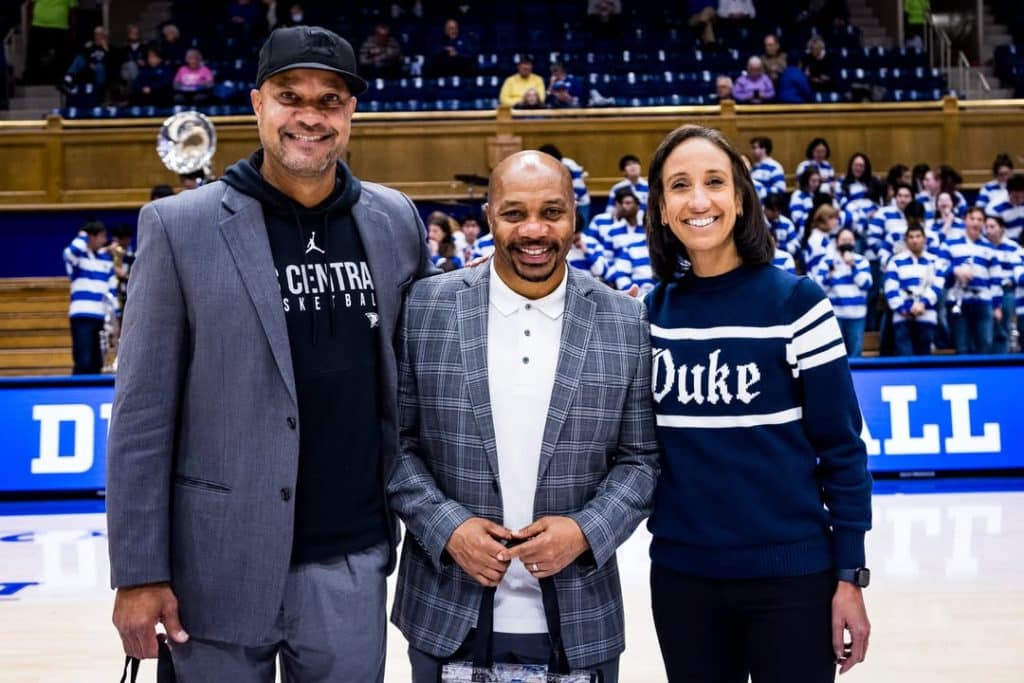
This transformation matters within the broader Durham context. The same city that once required secrecy for interracial competition now sees Black administrators overseeing multimillion-dollar departments, negotiating conference realignments, navigating NIL policy, and shaping national athletic strategy.
Despite the growth of executive leadership and national visibility, Durham’s sports story still begins locally. Public school programs, particularly at Hillside High School, continue to produce elite talent. Athletes such as Greg Little carried Durham pride from neighborhood fields to national recognition. As an All-American who advanced to UNC and eventually the NFL, Little’s journey reflected the durability of Durham’s grassroots infrastructure.
His rise reinforced a pattern that stretches back to Hillside Park High School’s early dominance. The fields may look different today. Recruiting now includes digital platforms and national rankings. Yet the foundation remains community-driven. Youth leagues, mentorship programs, and local coaches continue to connect athletics with academic responsibility and character development.
Durham’s Black sports culture has long understood that sport is not an endpoint. It is a vehicle. It provides scholarships, exposure, and opportunity, but it also reinforces discipline, pride, and civic responsibility. That philosophy continues to shape the pipeline from Durham neighborhoods to collegiate and professional arenas.
The period from 2000 to the present day reveals a Durham that has moved from exclusion to influence. In earlier eras, African Americans built parallel systems under Jim Crow. They established leagues, clubs, and schools when access was denied. They risked arrest and reputational harm to compete across racial lines Their goal was entry. Today, the goal is sustainability.
The challenges have evolved. NIL agreements reshape recruiting landscapes. Social media magnifies athlete visibility. Conference realignment redefines institutional alliances. Yet Durham enters this era with something earlier generations fought hard to secure: institutional presence.
Black Durham does not stand outside the system looking in. It is embedded within the system, influencing it. From El Toro Park to Division I stadiums. From the Algonquin Tennis Club to executive boardrooms. From whispered games to national broadcasts. Durham’s Black sports history is not a straight line. It is a continuum. Each era layered upon the one before it. Each generation inherits responsibility along with opportunity.
As Black History Month comes to a close, we celebrate and reflect those who blazed the trail. But the impact of Black leaders in Durham goes far beyond just February. We celebrate Black leadership, innovation, and athletic greatness in Durham sports today and every day.