
By William Townsend
After an era of revitalization and change for African American sports in Durham, acceptance was officially in place for Black athletes. A new era had come into the frame, with many athletes breaking barriers in the face of adversity. These pioneers not only lifted their communities but also made waves at new institutions. What followed in the 1970s, 1980s, and 1990s was not simply participation, but sustained excellence. Durham’s Black athletes became champions in every sense of the word.
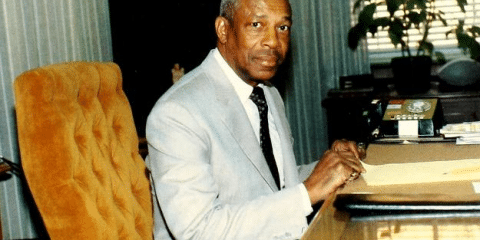
The 1970s marked a period of dominance and national recognition for Black collegiate athletics in Durham, led by Leroy T. Walker at North Carolina Central University. Walker’s impact on Durham sports cannot be overstated. As head coach of NCCU’s track and field program, he built one of the most successful collegiate track dynasties in the country. Under his leadership, NCCU athletes captured multiple national titles and individual championships, regularly outperforming programs with far greater resources. Under Walker’s reign, the Eagles produced 30 national titles, 77 All-Americans, and five Olympic medalists. Walker’s teams did not simply compete at the national level, they set the standard. Beyond the wins, Walker’s greatest legacy was the athletes he developed. He coached and mentored Olympians and world class competitors, including gold medalists and record holders who carried Durham’s name onto the global stage.

While NCCU solidified its standing in the 1970s, Durham’s high schools continued to function as cultural anchors through this era. Hillside High School remained a cornerstone, producing athletes who carried the city’s identity with them wherever they competed. Among the most influential was Rodney Rogers, whose journey represented a full-circle moment for Durham sports. A standout at Hillside, Rogers embodied the power of Durham’s public school system to cultivate elite talent. Drafted into the NBA in 1993, he built a career defined by toughness, versatility, and longevity. His later recognition as NBA Sixth Man of the Year validated not only his individual success, but also the environment that shaped him. For Durham’s Black community, Rogers was proof that national recognition could begin on local courts. His visibility inspired younger athletes and reinforced the importance of investing in community based programs and schools.

As Durham entered the 1990s, the city’s sports identity expanded further through the national prominence of Grant Hill. Hill’s arrival at Duke University coincided with the program’s rise to the pinnacle of college basketball. Leading Duke to back to back national championships in 1991 and 1992, Hill became one of the most recognizable athletes in America. Yet his impact in Durham extended beyond wins and accolades. Hill represented a new model of Black athletic leadership at a historically white institution. He was visible, respected, and embraced by the broader Durham community. He even championed change in his community. His presence normalized Black excellence in spaces once defined by exclusion and reshaped the city’s relationship with Duke athletics. For many in Durham, Hill symbolized a turning point where Black athletes were no longer exceptions, but leaders of their community and championship culture.

Professional sports also reemerged as a defining force in the 1990s, most notably through the return of minor league baseball to downtown Durham. The opening of the Durham Bulls Athletic Park in 1995 marked a symbolic homecoming for the city. While the Bulls were no longer segregated as in earlier eras, their resurgence was deeply connected to Durham’s Black sports legacy. The stadium became both a physical and cultural landmark, tying athletics to urban revitalization and renewed civic pride. The Bulls’ rise to Triple A status in 1998 further positioned Durham as a legitimate professional sports city, one built on decades of Black athletic contribution.
Across the 1970s, 1980s, and 1990s, black athletes in Durham illustrate a shared truth. Durham’s Black sports history is not defined by isolated moments, but by continuity. High schools fed colleges. Colleges shaped professionals. Professionals reflected the city back to itself. These champions of color did more than win games. They altered perceptions, expanded opportunity, and embedded sports deeper into Durham’s cultural identity.
The foundation laid by these athletes and leaders now supports a new generation navigating NIL opportunities, digital visibility, and evolving professional pathways.